

 Web platform
Real estate · CRE
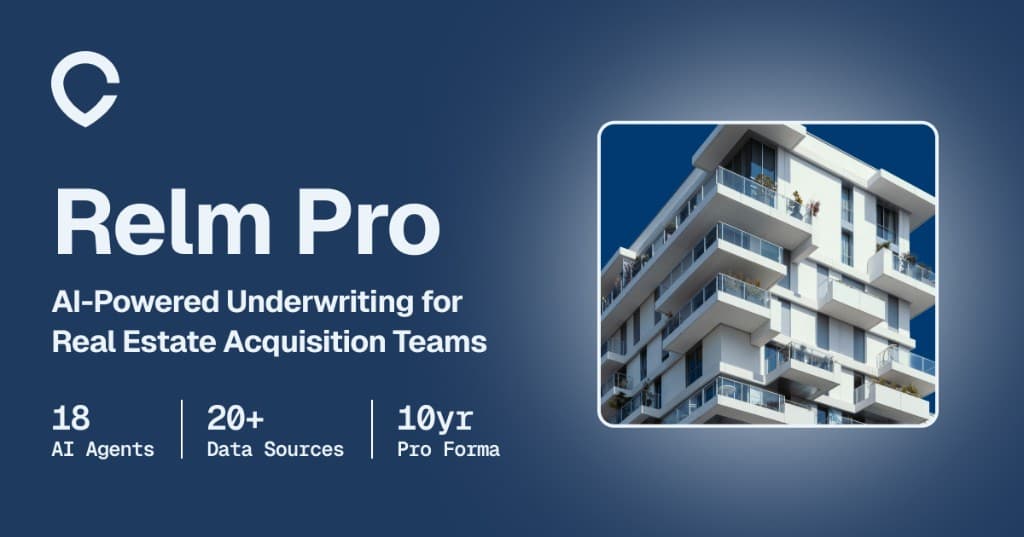
Relm: multi-agent AI that finds hidden deal risk in commercial real estate
Minutesaddress to Intel Report
Scalable backends, cloud architecture, DevOps and cost optimization on AWS, Azure and GCP, so your product stays fast, secure and affordable as it grows.
 What you get
Services, data and event flows designed for scale.
Right-sizing, reserved capacity and waste removal.
Automated builds, tests and zero-downtime deploys.
Terraform or Pulumi for repeatable environments.
IAM, encryption, backups and SOC 2 readiness.
Logs, metrics, tracing and on-call alerting.
Current cost, risk and bottlenecks.
Target architecture and plan.
Phased, zero-downtime moves.
Monitor, optimize, support.
LLM costsOn an AI product, model calls can outgrow the rest of the cloud bill. Four levers cut them without changing what users see; three are published price multipliers, from Anthropic’s pricing page, checked October 18, 2026.
Work that can wait, such as nightly summaries or bulk classification, goes through the Batch API at 50% off both input and output tokens.
A cache hit costs 0.1x the base input price on most Claude models, 0.05x on Sonnet 5.5 and Opus 5.5, and 0.025x on Fable 5.1 and Mythos 5.1. A 5-minute cache write costs 1.25x, so a long system prompt pays off after one reuse.
A small model handles routine requests and hands hard ones to a larger model. The routing rule is tested on the same evaluation set as the product.
US-only inference costs 1.1x the standard rate (10% more) on every token category on Claude 4.6 and later models. Turn it on when a contract requires it, not by default.
A model on your own GPUs swaps per-token fees for a fixed bill. It pays off at steady, high volume, or when policy rules out external model calls. Private RAG deployment
Anthropic’s published API prices. The multipliers stack with each other, and rates change, so we re-check them in every audit. Anthropic pricing
Our rule: give every AI feature a monthly cost budget with an alert before reaching for a cheaper model.
Build or buyManaged platforms are the right start. Own the architecture once cost or limits start to hurt.
| Your situation | Our recommendation |
|---|---|
| An early product with a small team | Stay on a managed platform like Vercel or Firebase |
| Growing traffic across several services | Containers on your cloud, defined in code |
| Spiky or event-driven workloads | Serverless functions and queues |
| A cloud bill growing faster than usage | Cost audit first |
Our recommendation: stay managed until the bill or the limits hurt, then move to infrastructure you own, in code.
Typical engagementAn audit of current cost, risk and bottlenecks, with a target architecture and migration plan.
Phased migration or new backend, all infrastructure as code, with zero-downtime deploys.
Monitoring, cost reviews and on-call support with agreed response times.
Built by one in-house team, from discovery to launch and support. AI makes us fast; a senior engineer decides what goes live. Meet the team
What moves the price: the number of services, environments and data stores, and how much downtime the migration can tolerate. Compare engagement models
Selected workWeb platform iOS · Android · WebGuidesFAQ
The audit shows where the money goes before we promise a number. We check right-sizing, reserved or committed-use capacity, idle and orphaned resources, storage tiers and data egress, then price each fix against its saving in your own billing data.
Yes. We move one service at a time, run the old and new versions side by side, shift traffic gradually and keep a rollback path at each step, so users never see a hard cutover.
Yes, through a monthly support retainer. Response times, hours of cover and escalation contacts are agreed in writing, and alerts go to your team and ours.
Most engagements start with a 2-week Discovery Sprint ($5,000 fixed fee, credited to your build), followed by a fixed-price build ($25k–$120k per project, 6–16 weeks) or a dedicated team (from $12k per month). The build price is fixed after discovery and billed in milestones tied to demoed features. For cloud work, the Discovery Sprint is the audit and target architecture. Your cloud provider bills you directly, in your own account, for the infrastructure itself.
The audit and target architecture take two weeks. A phased migration is a fixed-price build of 6–16 weeks, moving one service at a time with a rollback path at each step.
Usually the one your team, customers and credits already favor. Azure suits Microsoft-heavy companies and Azure OpenAI; AWS has the widest service range and Bedrock; GCP is strong for data and Vertex AI. We keep core services portable.
By routing simple requests to smaller models, caching repeated prompts and embeddings, batching background jobs, setting per-feature budgets with alerts, and self-hosting models only where volume justifies the GPU cost.
You do. Everything runs in your cloud accounts and is defined in Terraform or Pulumi in your repository, so environments are reproducible and nothing depends on our access.
Yes, on the technical side: IAM, encryption, backups, logging and change management set up the way auditors expect. The audit itself is done by an independent firm; we are not an auditor.
Yes. We deploy into an EU region such as Frankfurt or Ireland and keep storage, backups and logs there. For model calls we pick your provider’s EU processing option, for example Google Vertex AI in its EU multi-region for the models that support it, or Azure OpenAI in the EU Data Zone, and pin the region in your infrastructure code so it can’t drift.
 Cookies, briefly
We use essential cookies to run the site and, with your OK, analytics and visitor identification. Privacy policy