

AI receptionist call routing: from demo to booked appointment
A receptionist demo answers the phone. A production voice agent has to book the slot. How a front agent routes each call so the agents behind it stay narrow.

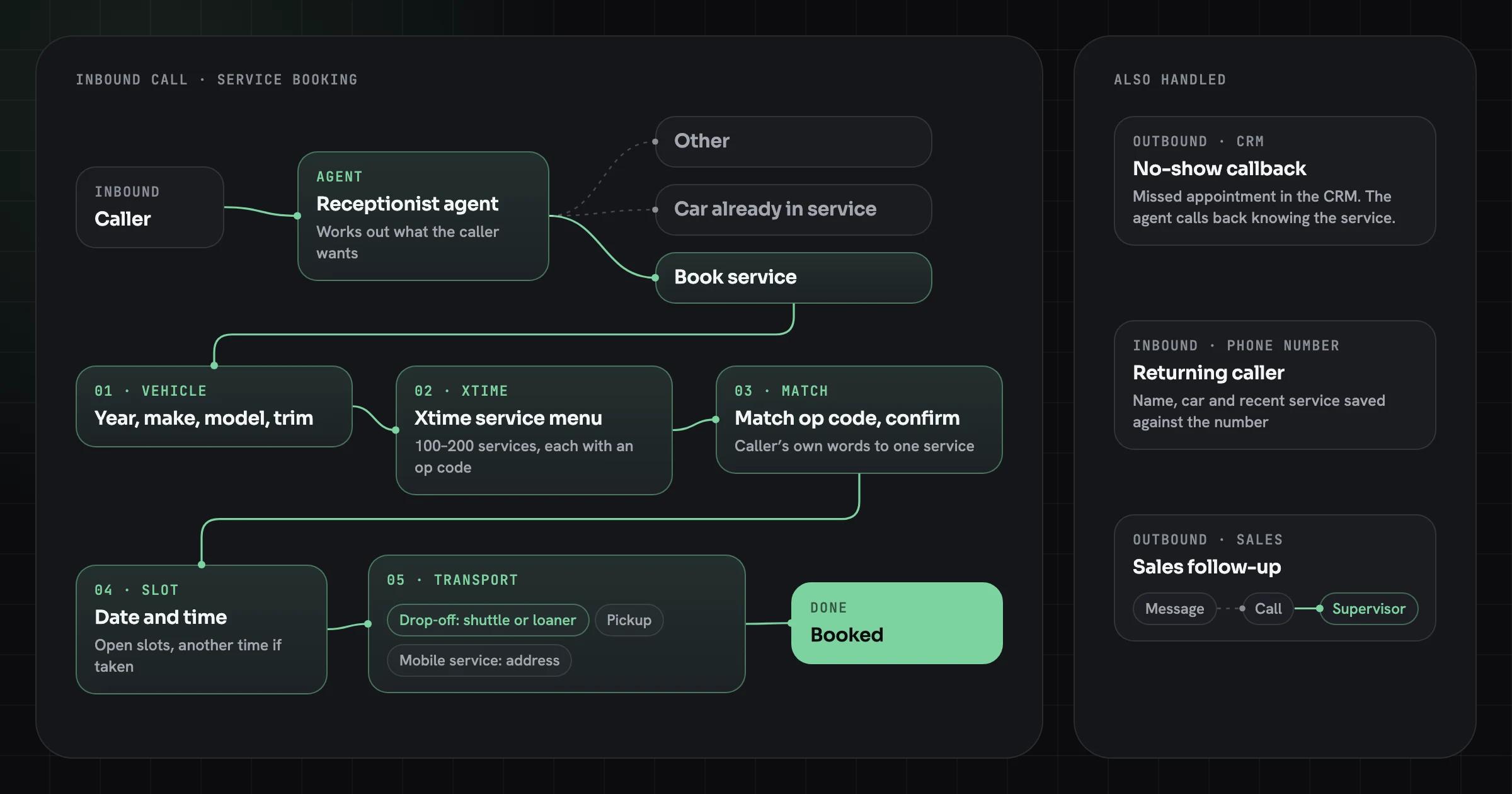
A receptionist demo answers the phone, greets the caller and handles a couple of questions. A production voice agent has to book the slot. On the dealership voice agents we built for Innovative AI, that meant settling four things on one call: the exact vehicle, the right service out of the 100–200 on that vehicle’s menu, an open time and a way to get the car in.
The gap between those two is mostly routing. The demo puts one agent on the line and asks it to do everything. The production system puts a receptionist agent in front whose only job is to work out what the caller wants, and hands the call to an agent built for that job. This guide covers how that split works, what booking needs before it can happen, and when a phone tree or one more person at the front desk is the better buy. It is the call design we use for custom AI voice agents and AI receptionists.
What is call routing for an AI receptionist?
Call routing for an AI receptionist is the step where the agent works out the caller’s intent and sends the call to the path that handles it. That path can be another agent, a person or a callback queue. Routing is a classification problem, and it is the first decision on every call.
Anthropic’s guide to building agents describes the same pattern under the name routing: it “classifies an input and directs it to a specialized followup task”, and works well “for complex tasks where there are distinct categories that are better handled separately”. Its first example is customer service queries sent to different downstream prompts and tools. Agent frameworks build it in. OpenAI’s Agents SDK, for example, exposes each handoff to the model as a tool, so a triage agent can transfer a caller to a billing or refund agent.
A keypad menu routes too, but the caller does the classifying by pressing 2. An AI receptionist asks an open question (“How can I help?”) and does the classifying itself.
Why a demo receptionist breaks on a real phone line
A demo receptionist breaks because one agent carries every instruction, every tool and every edge case at once. With two call types that holds up. With five, the prompt mixes booking rules with status lookups and policy answers, and a change for one call type can break another that you didn’t retest.
Real phone lines carry several kinds of calls. A dealership line carries service bookings, questions about a car already in the shop and calls about everything else. Each needs different data and ends differently: a booking ends with an appointment written to the scheduler, a status question ends with an answer, and a complaint ends with a person.
Splitting the work lets you treat each call type as its own small system:
- Shorter instructions. The booking agent only carries booking rules, so it never has to decide whether the caller is booking at all.
- Fewer tools per agent. An agent that can only read the menu and write appointments can’t call the wrong system.
- Tests per call type. You can replay a week of booking calls against the booking agent alone and see what changed.
- Failures you can locate. When a call goes wrong, the transcript shows whether the route or the task failed.
The cost is one more step on every call. The handoff has to be fast and invisible to the caller, which is a latency question as much as a design one; our guide to voice agent latency covers that budget.
How the front agent routes a call in production
On the Innovative AI system, a receptionist agent takes every inbound call first. Its only job is to work out what the caller wants and hand the call to the agent built for that. The agents are still live in production.
We built the receptionist around three paths: book a service, check on a car already in the shop, or something else. By the time the booking agent speaks, the intent is settled. For a phone number the system already knows, so are the caller’s name, car and last service, which are saved against the number from earlier calls.
| Step | Front agent (receptionist) | Agent behind it |
|---|---|---|
| Greeting | Answers and asks what the caller needs | Not on the call yet |
| Intent | Picks one path, or asks one clarifying question | Receives the settled intent |
| Caller record | Arrives with the call when the number is already known | Confirms the record instead of asking again |
| Task | Doesn’t book, look up or answer policy questions | Does one job with its own tools |
| Unclear or out of scope | Sends the call to a person or a callback with a summary | Hands back if the request turns out to be something else |
Three rules we recommend for any front agent:
- Ask rather than guess. If the first sentence could mean two things, ask one short question. A wrong route costs the caller their first minute.
- Confirm a saved caller, don’t assume one. A phone number identifies a line. Households share phones and cars, so a quick “Is this about the Camry?” beats a booking for the wrong vehicle.
- Pass a summary with every handoff. Whoever takes the call next, agent or person, should start from what the caller already said.
The case study on Innovative AI’s dealership voice agents covers the rest of the system, including its outbound calls.
What a booking needs before it exists
A booking exists only when the agent has every field the scheduler needs and the caller has agreed to them. On the Innovative AI build there were four, collected in order, and the booking agent wrote nothing until all four were settled.
- The exact vehicle. Year, make, model and trim, because the service menu depends on the car.
- The right op code. The caller describes the job in their own words, and the agent picks the matching entry out of the 100–200 services on that vehicle’s menu, each with its own op code.
- An open slot. The agent checks the requested time against the dealership’s open appointments and offers another time if it is taken.
- A transport choice. Drop-off (with a shuttle or loaner if needed), pickup by the dealership or mobile service at home, with an address asked for only when the option needs one.
Before booking, the agent reads the service back and goes on only once the caller agrees. A wrong op code books the wrong job, so that confirmation is in every booking.
This is where a demo and a production agent differ most. A demo can say “You’re all set for Tuesday” without anything behind it. A production agent can only say it after the scheduler has accepted the appointment. Our guide to AI service scheduling for dealerships walks through each of the four steps from the caller’s side, including what to do when no menu entry matches.
Other businesses have their own four fields. A clinic needs the patient, the visit type, the provider’s open slot and the location. A field service company needs the address, the job, the window and the access details. Write the list down before any prompt: it decides what the booking agent asks and in what order.
Where routed calls still fail
Routing narrows the failures but doesn’t remove them. On the Innovative AI build, the bookings that didn’t complete failed for three reasons: requests too odd or ambiguous to match to a service, accents and pronunciation the speech recognition misheard, and heavy background noise at the caller’s end.
None of those is a routing failure, but routing decides what happens next. A narrow booking agent knows when it is stuck, because it is stuck on one question: which service the caller means. That makes a clean exit easy to design. We recommend that after one failed clarification the agent offers an advisor or a callback and passes on what it already has, so the call ends with a next step instead of a hang-up.
Track routing separately from booking after launch. Count calls by the path the front agent chose, the handoffs to people by reason, and calls that were sent to one agent and handed back. A rising hand-back rate means the front agent is guessing.
When a phone tree or better staffing wins
A phone tree wins when callers need a destination, not an outcome; better staffing wins when the calls need judgment and the volume fits in business hours. An AI receptionist earns its build cost when many callers need something done, such as a booking, at hours or volumes your staff can’t cover. We build the third option, so weigh this table with that in mind.
| Your calls look like this | Better fit | Why |
|---|---|---|
| Callers want a department, extension or mailbox | Phone tree (IVR) | Fixed destinations need no understanding; keep the menu to one or two levels |
| A few call types, all answered in business hours, and the desk keeps up | Staff, maybe a better schedule | Nothing is being lost; automation adds cost and a new failure mode |
| Calls need judgment, negotiation or empathy (complaints, disputes, sensitive news) | Staff | A person handles these better; an agent should route them, not answer them |
| Most calls are bookings or status checks against a system you can connect | AI receptionist with routing | The task is repeatable and the data exists to complete it on the call |
| Bookings arrive after hours or several at once | AI receptionist with routing | A single receptionist covers one call at a time, in staffed hours only |
| Your scheduler has no way for an agent to read slots and write bookings | Staff or IVR for now | An agent that can’t book is only a slower message taker |
GetVoIP’s comparison of the two makes a similar point from the IVR side: for pure high-volume transactional sorting, it says, “a menu is faster and cheaper than any conversation.”
Staffing is easy to size. The Bureau of Labor Statistics puts the 2025 median pay for receptionists at $18.27 an hour. A full-time receptionist covers about 40 of the 168 hours in a week, roughly 24%, and one call at a time within those hours. If your missed calls fall inside those 40 hours and rarely overlap, a second person or a better lunch rota is the cheaper fix. If they fall at night, on weekends or in bursts, a person can’t cover them at that price, and an agent can.
How to scope an AI receptionist that books
Start from the call log, not the demo. A week of recorded calls shows which intents your line carries, how many of them are bookings and how far callers’ words sit from the items in your booking system. From that, the scope writes itself:
- The paths. The intents the front agent routes on day one, and where everything else goes.
- The fields. For each bookable path, the fields the scheduler needs and the order the agent asks for them.
- The confirmation. What the agent reads back before it writes anything.
- The exits. When the agent hands over to a person, and what summary goes with the call.
- The measures. Booking completion among callers who chose to book, handoffs by reason and hand-backs from the routed agents.
A routed receptionist with booking falls in our $25k–$120k fixed-price band, set after a Discovery Sprint. The number of paths and booking-system connections moves it within the band more than the conversation does; the pricing page explains how the band is set.
Before any of that, check whether the calls you miss are worth the build. Put your call volume, missed-call share and customer value into the AI voice agent ROI calculator, and our guide to the cost of missed calls shows the formula behind it.
Sources
- Building effective agents, Anthropic (Dec 19, 2024)
- Handoffs, OpenAI Agents SDK documentation, as of October 2026
- Receptionists: Occupational Outlook Handbook, U.S. Bureau of Labor Statistics
- AI Receptionist vs IVR: How Each Handles Your Calls and Which Fits You Best, GetVoIP (Jul 9, 2026)
