

Innovative AI: voice agents that book dealership service
AI voice agents for US car dealerships: a receptionist that routes each inbound call, service booking in Xtime, and follow-up calls for no-shows and unsold leads.
01 · Challenge
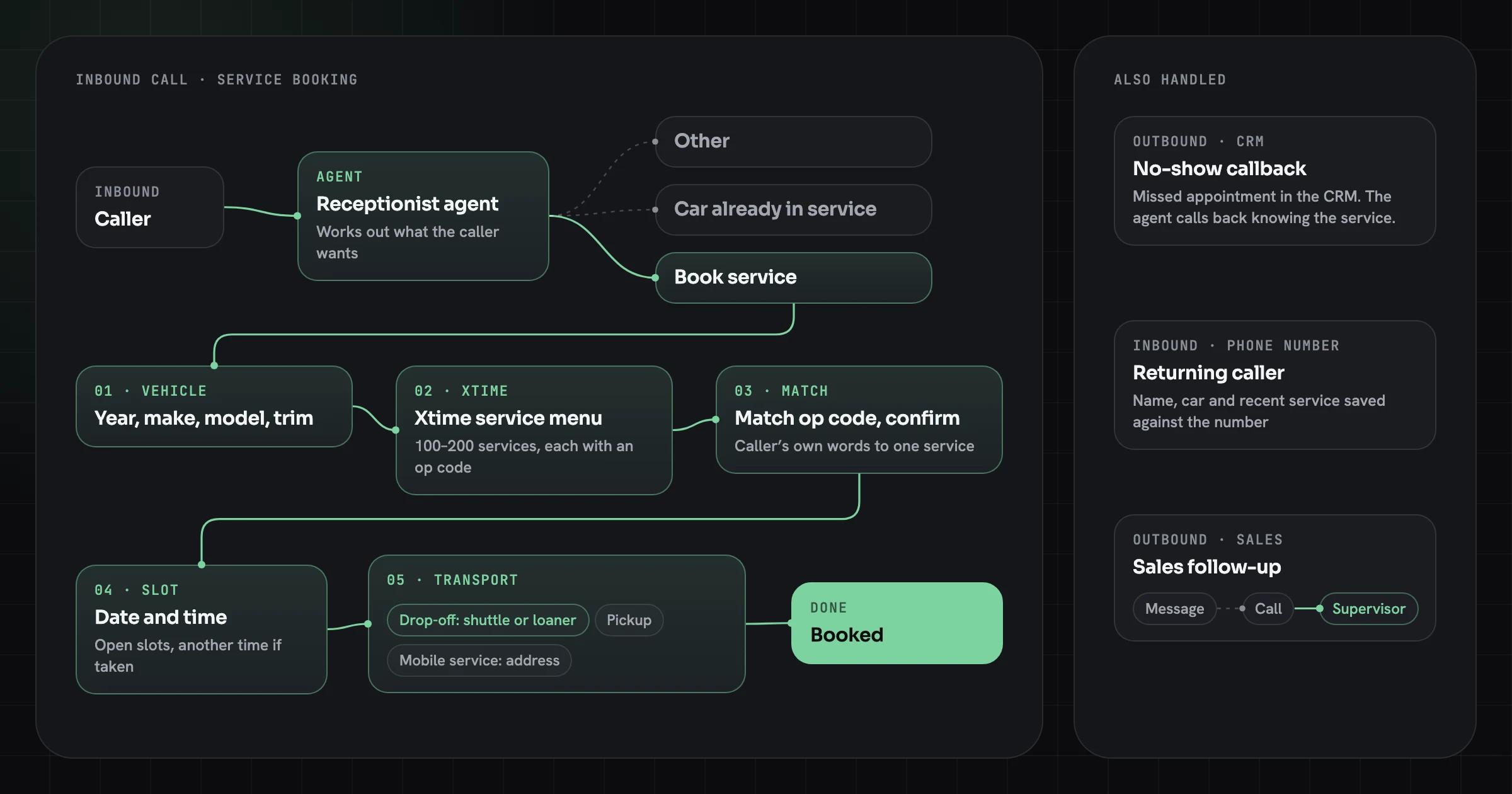
A dealership service booking needs four things before it exists: the exact vehicle, the right service out of the 100–200 on that vehicle’s menu, a free slot and a way to get the car in. Innovative AI needed voice agents that could collect all four on a phone call and book the result in Xtime, Cox Automotive’s service software. The same system also had to follow up by phone with customers who missed an appointment and with sales leads who left without buying.
02 · Approach
 A receptionist agent in front, routing each call to an agent built for one job.
- Service booking against each vehicle’s Xtime menu, from the caller’s words to a confirmed op code, slot and transport choice.
- Outbound agents for no-shows and for sales leads who left without buying.
- Caller memory keyed to the phone number, plus lookup of existing appointments.
03 · Results
- Of callers who went ahead with booking through the agent, 99% were booked, by our own count.
- The rest failed on requests too odd or ambiguous to match, on accents and pronunciation, and on heavy background noise at the caller’s end.
- The agents are still live in production.
Build notesHow we built it
Routing first
A dealership line carries several kinds of calls, and each needs a different job done. Booking a service, checking on a car already in the shop and asking about something else are separate conversations with separate data behind them. So the first agent on each incoming call was a receptionist. Its only job was to work out what the caller wanted and hand the call to the agent built for that.
Keeping that step separate kept each agent behind it narrow. The booking agent never had to guess whether a caller was booking or asking a question. By the time it spoke, the intent was settled, and for a number the system already knew, so were the caller’s name, car and last service.
Service menus and op codes
The booking agent started with the vehicle, not the problem. It asked for the year, make, model and trim, because the menu depends on the car: Xtime returned the services available for that vehicle. In the menus we worked with, that list ran to 100–200 services per vehicle. Each one carried its own op code, the code that identifies that service job.
Callers don’t speak in op codes. A caller might say the car pulls to one side, ask for “the usual service” or need two new tires. The agent’s job was to map those words onto one entry in that vehicle’s menu, read the service back and move on only once the caller agreed. A wrong op code books the wrong job, so the confirmation stayed in every booking. Our guide on how AI service scheduling works at a dealership walks through the same call from the caller’s side.
Slots and transport
With the service fixed, the agent asked when the caller wanted to come in and checked that time against the dealership’s open appointments. If the slot was taken, the agent didn’t end the call or pass it to a person. It offered other open times and settled on one with the caller.
Then came transport. The caller could drop the car off, have the dealership pick it up, or book mobile service, where the dealership services the car at the caller’s home. Pickup and mobile service need an address, so the agent asked for one only in those two cases. Drop-off callers were asked whether they needed a shuttle or a loaner. Only when the vehicle, the op code, the time and the transport were all settled did the agent book the appointment.
The agent could also look up and confirm an appointment a caller had already made.
Outbound calls: no-shows and unsold leads
The system also placed calls instead of only answering them.
One kind of call handled no-shows. When the dealership’s CRM showed that a customer hadn’t arrived for a booked appointment, the agent called them. It already knew which service had been scheduled, so the call didn’t start from zero. It asked the customer questions about the missed appointment and could rebook or handle whatever the customer asked for instead.
The other followed up on sales leads: people who had come to the dealership and left without buying. The agent sent a message first, then called to find out why. The reason could be the price, a different car or something else. The agent tried to bring the lead back in, captured what they were looking for and told them a supervisor would call back. Our guide to no-show and lead follow-up calls covers how to run both kinds of outbound call.
Why the last 1% failed
The bookings that didn’t complete failed for three reasons we saw on the calls. Some requests were too odd or ambiguous to match to any op code, and those callers got annoyed when the agent couldn’t follow them. Some accents and pronunciations were misheard. Some calls came from places so loud that the agent couldn’t pick out the words.
Misheard accents are not a quirk of this build: published research has measured speech recognition doing worse for some groups of speakers than others, and our service scheduling guide cites the study. Any voice agent that books appointments should be planned for the call it won’t understand, with a clear way to a person or a callback before the caller gives up.
The systems behind the calls
The dealership systems behind these calls all come from Cox Automotive. Service booking runs through Xtime and sales follow-up through VinSolutions, Cox Automotive’s dealership CRM. Xtime’s own site calls Xtime “part of a powerful ecosystem of retail solutions from Cox Automotive”, and VinSolutions’ site uses the same words about VinSolutions (both checked October 18, 2026).
Other dealerships run on other Cox Automotive systems, and the agents were set up for those. Our Xtime API integration guide covers what connecting a voice agent to Xtime involves, and car dealership software covers the other dealership systems we build for.
The productFrom a phone call to a booked service slot.
Call routing
A receptionist agent worked out whether the caller wanted to book service, check on a car already in the shop or something else, then routed the call.
Vehicle-specific menus
Year, make, model and trim came first, then that vehicle’s service list from Xtime, 100–200 services long.
Plain words to op codes
Callers described the job in their own words. The agent picked the matching op code and read it back for confirmation.
Slot check
The agent checked the dealership’s open appointments and offered another time when the requested one was taken.
Transport
Drop-off with a shuttle or loaner, pickup by the dealership, or mobile service, with the address asked for only when needed.
Returning callers
Name, car and recent service were saved against the phone number, and existing appointments could be looked up and confirmed.
How it works
- STEP 01
Route
The receptionist agent learned what the caller wanted and passed the call on.
- STEP 02
Match the service
The agent mapped the caller’s words to an op code on that vehicle’s menu and confirmed it.
- STEP 03
Find a slot
It checked open appointments and agreed a time, offering another if the first was taken.
- STEP 04
Arrange transport and book
It settled drop-off, pickup or mobile service, then booked the appointment.
IntegrationsWired into the systems that matter.
- Xtime (Cox Automotive)
- VinSolutions (Cox Automotive)
- Dealership CRM
- Phone line
Built and shipped for Innovative AI.
- Voice agents
- Intent routing
- Op-code matching
- Slot negotiation
- Outbound follow-up
- Caller memory
FAQAbout this build.
Which dealership systems do the agents work with?
Xtime, Cox Automotive’s service software, for service scheduling, and VinSolutions, Cox Automotive’s dealership CRM, for sales follow-up. When the dealership’s CRM shows a customer hasn’t arrived, the agent calls them. The agents are still live in production.
How often did the booking agent complete a booking?
Of callers who went ahead with booking through the agent, 99% were booked, by our own count. The rest failed on requests too odd or ambiguous to match to a service, on accents and pronunciation, and on heavy background noise at the caller’s end.
Did the agent remember returning callers?
Yes. The caller’s name, car and recent service were saved against their phone number, so the next call from that number didn’t start with the same questions. The agent could also look up and confirm an appointment the caller had already made.
- Services used
- AI Voice AgentsAI Agent Development
- Industry
- Automotive & Dealerships
Building something similar?
Start with a free AI audit. You get a fixed-price plan after a 2-week discovery sprint.
