

Dealership no-show and lead follow-up calls with AI voice agents
A customer booked service and didn’t arrive. The call that follows should already know the car, the service and the time. How the no-show call and the unsold-lead call worked on a real dealership build, and the consent each one needs.

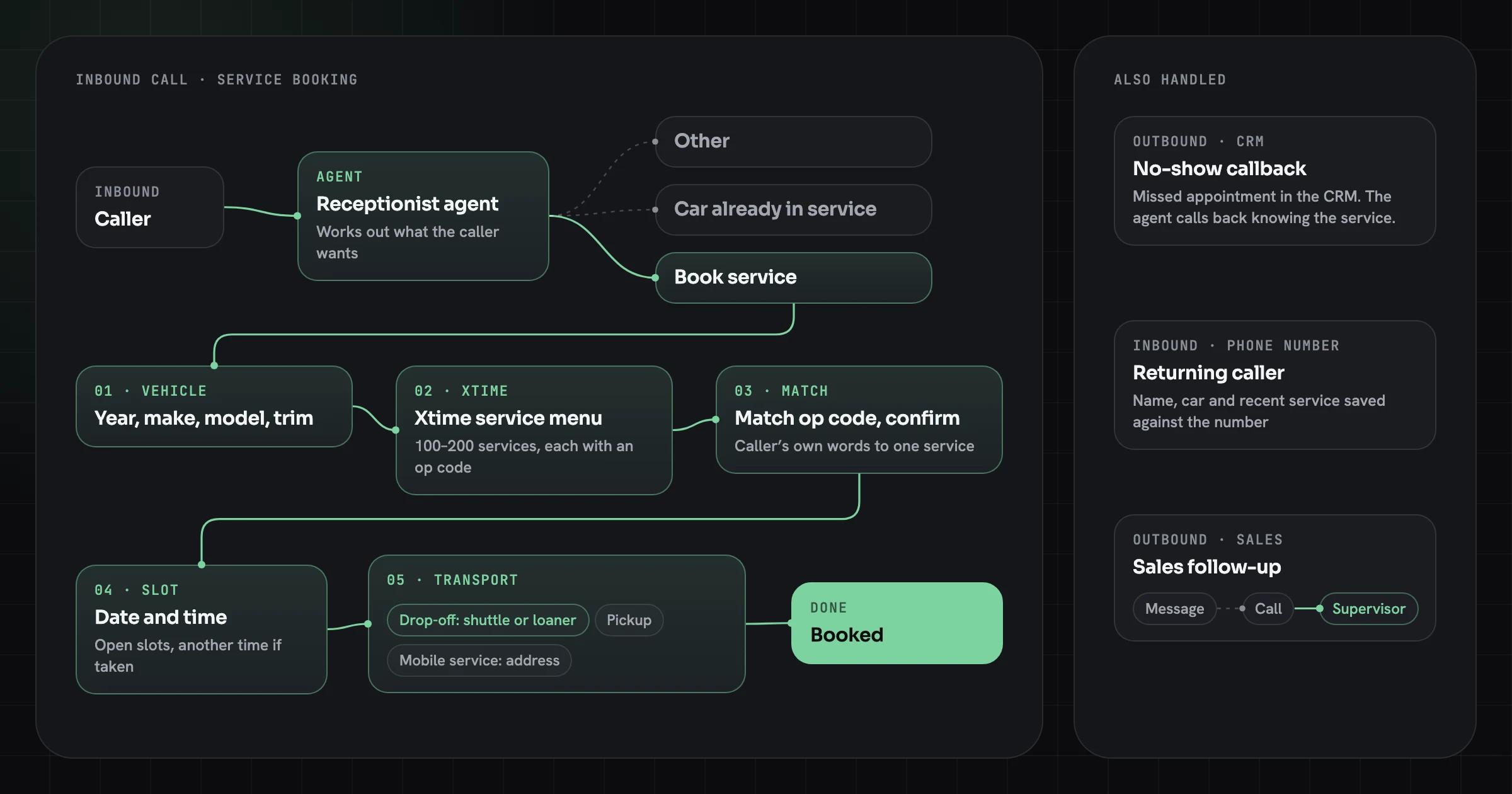
A customer booked a service, picked a slot and never arrived. The appointment sits in the dealership’s CRM with no repair order behind it. The call that follows should already know the car, the service that was booked and the time that was missed, so its first question is “Would you like to rebook?”, not “What can I help you with?”
That is how the follow-up works on the custom AI voice agents we built for Innovative AI, which are still live in production for US car dealerships. The same system has a second outbound job: calling sales leads who visited or inquired and didn’t buy. Both calls are easy to get wrong, because each one needs the right context and the right consent.
The stakes are visible in the service lane. In Cox Automotive’s Service Industry Study (published November 11, 2025; 1,974 vehicle owners), 54% of owners of cars two years old or newer returned to the selling dealer for service, down from 72% in 2023. An appointment that lapses without a call is one more chance for an owner to try someone else.
When should a no-show call go out?
A no-show call should go out when the CRM marks the appointment as missed, not on a fixed timer from the booked slot. On our Innovative AI build, the trigger was the CRM showing that the customer hadn’t arrived; the agent then placed the call.
The status matters more than the clock. A customer who is 20 minutes late is still a customer on the way, and a call to them reads as nagging. A status set by the service desk, or by the absence of a check-in by the end of the slot, is a fact the agent can act on.
How long to wait after the status changes is a judgment, and the right window depends on the dealership. Our recommendation: call the same day while the customer still remembers why they booked, inside normal hours, and after one unanswered attempt, hand the record to a person. We don’t have measured cadence data from the build to publish, so treat that as a starting point to test, not a benchmark.
What the agent knows before it dials
The agent should start the call already holding the appointment and the customer record, so the customer never repeats what they told the dealership when they booked. On our build, every follow-up call carried the scheduled service the customer had missed.
The same build saved customer data against the phone number: the caller’s name, their car and their recent service. When the same number called again, the agent used that record instead of asking for the vehicle a second time. A no-show call can use the same record in reverse. Before dialing, the agent should load:
- The booking: the service that was scheduled, the slot that was missed and the transport choice (drop-off, pickup or mobile service).
- The vehicle: year, make, model and trim, which decide the service menu the agent can rebook from.
- The customer: the name on the record and any earlier service, so the agent can confirm it is talking to the right person.
- The consent record: which number may be called, for what purpose, and whether the customer has opted out.
The last item is the one teams forget. A record without a consent flag is a reason not to dial.
Rebooking on the same call
The point of the call is to end it with a new appointment, so the agent should be able to book on the spot instead of promising that someone will call back. On our build, the agent asked the customer questions about the missed appointment, then rebooked the service or did whatever the customer asked.
We recommend that rebooking reuse the inbound booking flow. The agent should offer the service that was on the original appointment, ask whether anything has changed, check open slots in the scheduler, offer the nearest alternative when the preferred time is taken, and settle transport again. A customer who missed a drop-off because they had no ride may want a loaner or pickup this time. The steps are covered in how the booking call works.
We recommend two different paths for two cases. If the customer says the work was done elsewhere, the agent should record that and close the follow-up. If they want to cancel, it should cancel and not argue. Both outcomes are as useful to the service manager as a rebooked slot, because they explain where the appointment went.
Unsold leads: message first, then call
For sales leads who came to the dealership or inquired and didn’t buy, our build sent a message first and called afterwards. The message should say who is following up and why, so the call that follows isn’t a surprise from an unknown number.
The order matters for two reasons. People screen calls from numbers they don’t know, and a message gives the call a reason to be answered. And a message lets the lead reply in their own time, which some people prefer to a conversation about a car they decided not to buy.
On the sales side, the build runs through VinSolutions, Cox Automotive’s dealership CRM; the service side books through Xtime, also part of Cox Automotive. One vendor behind both sides doesn’t make them one system, so plan for the follow-up logic to read lead status and appointment status from wherever each one lives.
Capturing the reason and handing off to a supervisor
The sales call’s job is to learn why the lead didn’t buy and pass a clear brief to a person, not to close the sale itself. On our build, the agent asked for the reason, such as the price or wanting a different car, tried to bring the lead back to the dealership or captured what they needed, and then told them a supervisor would call them.
We recommend a callback over a live transfer. A salesperson who calls back with the lead’s budget, preferred model and objection already in the CRM has a better first minute than one who picks up a transferred call cold. The agent should repeat its summary to the lead before ending the call (“You’re looking for a hybrid under the price you saw, and a supervisor will call you”), which catches mistakes while the lead is still on the line.
The whole build, service and sales side, is written up in the Innovative AI case study, and what we build for dealer groups and dealer software vendors is on our car dealership software page.
US consent rules for AI follow-up calls
In the US, both follow-up calls count as artificial-voice calls, and the consent they need depends on whether the call is informational or telemarketing. The FCC’s declaratory ruling of February 8, 2024 (FCC 24-17) confirmed that the TCPA’s restrictions on artificial or prerecorded voice encompass current AI technologies that generate human voices. Such calls need prior express consent, and prior express written consent when they include an advertisement or constitute telemarketing.
The table splits the two calls by type. It is our reading of the ruling and of 47 CFR 64.1200 as published on October 18, 2026, not legal advice; state laws can add to it.
| Rule | Service no-show reschedule | Unsold sales lead |
|---|---|---|
| Call type | Informational, about a booking the customer made | Telemarketing: the aim is a sale |
| Consent | Prior express consent | Prior express written consent |
| Identify the business | At the start of the call | At the start of the call |
| Callback number | During or after the message | During or after the message |
| In-call opt-out | Honor any reasonable request | Automated voice or key-press opt-out within 2 seconds of the identification |
| Opt-out deadline | Within 10 business days | Within 10 business days |
| Calling hours | The hours rule covers solicitations; we keep to normal hours anyway | No calls before 8 a.m. or after 9 p.m., called party’s local time |
| Do-not-call registry | Not a solicitation; honor the dealership’s own list | Scrub against the national registry |
The no-show column assumes a consented call to a mobile number. To a residential landline under the informational exemption, 64.1200(b)(3) also requires the automated voice or key-press opt-out within 2 seconds of the identification.
A no-show call can drift into the right-hand column. If the agent adds an upsell (“While it’s in, would you like a tire rotation?”), our reading is that the call now carries telemarketing content, and the stricter consent applies. Keep the reschedule call to the reschedule.
Revocation rules changed recently. Since April 11, 2025, consumers may revoke consent by any reasonable method, and the caller must honor it within 10 business days. The separate “revoke-all” provision, which would make one opt-out cover unrelated calls from the same caller, has been delayed to January 31, 2027. The FCC’s one-to-one consent rule for lead forms was vacated by the Eleventh Circuit in January 2025.
AI disclosure is still a proposal. In August 2024 the FCC proposed rules that would require callers to say at the start of each call that it uses AI-generated technology; the current text of 64.1200 has no such rule as of October 18, 2026. We would disclose anyway, because a customer who finds out mid-call feels misled. The engineering cost of consent capture, scrubbing and opt-out handling is covered in our AI voice agent cost guide.
European and UK dealers
In the EU and the UK, the AI disclosure is already required or the consent bar is higher than in the US. Under Article 50 of the EU AI Act, people must be told they are interacting with an AI system from the start of the first interaction, and the Commission’s FAQ says Article 50 applies from August 2, 2026. The exception for cases where AI use is “obvious” is to be read restrictively, so a voice agent should say what it is in its opening line.
In the UK, the ICO’s guidance under PECR says you must not make automated marketing calls unless the person has specifically consented to that type of call from you. General marketing consent, or consent to live calls, is not enough. An AI sales follow-up to a UK lead needs that specific consent on file; a service reschedule that sells nothing is a different question, and personal data in both falls under data protection law. The EU AI Act and GDPR checklist covers the notice and the records.
What to log on every follow-up call
Every follow-up call should end with one outcome code, written back to the CRM, so a person can see what happened without listening to the recording. These are the codes we recommend; they are not counts from the build.
- Rebooked: new appointment ID, service and slot.
- Declined: the customer doesn’t want to rebook or buy, with the reason in their words.
- Done elsewhere or bought elsewhere: where the work or the sale went, if they said.
- Callback booked: for sales leads, the summary the supervisor will read before calling.
- Opt-out: the request, the time and the number, pushed to the suppression list at once.
- No answer or voicemail: with the attempt count, so the next step is a person, not another dial.
- Wrong number: removes the number from the record.
- Escalated: a complaint or a question the agent couldn’t answer, routed to staff.
Log the consent basis with each call as well. If a regulator or a customer asks why the agent called, the answer should be one lookup away.
When not to automate the follow-up
Don’t automate a follow-up that already works, and never automate one the customer has asked you to stop. If a text reminder the day before already keeps missed appointments low, an AI call adds cost and risk for little gain.
Keep a person on the call when the record shows a complaint, a dispute over a bill or a sensitive repair. Keep a person, too, when the lead is a fleet or business account with its own relationship. And if the consent record is missing or unclear, the right outcome is no call at all.
When the numbers do justify it, we would build the follow-up as an extension of a booking agent rather than a separate product, because it reuses the same scheduler and CRM connections. We scope that as part of a fixed-price build ($25k–$120k). If you run a dealership or a dealer software product, book a free AI audit and bring your no-show and lost-lead process; we will tell you which follow-ups are worth automating and which should stay with your team.
Sources
- Implications of Artificial Intelligence Technologies on Protecting Consumers from Unwanted Robocalls and Robotexts, Declaratory Ruling (FCC 24-17), Federal Communications Commission
- 47 CFR 64.1200, Delivery restrictions, Electronic Code of Federal Regulations
- FCC Issues One-Year Limited Waiver of New TCPA Consent Revocation Rule, Kelley Drye
- New Cox Automotive study finds dealerships have lost 12% of service visits to competition since 2018, Cox Automotive
- Telephone marketing (Guide to PECR), Information Commissioner’s Office
- Auto Dealership CRM & Sales Software, VinSolutions (Cox Automotive), as of October 18, 2026
- Transparency obligations under Article 50 of the AI Act (FAQ), European Commission
