

AI voice agent cost in 2026: per-minute vs custom build
About $0.08 to $0.15 a minute on a hosted platform, $0.04 on a custom stack: the line items behind each rate, plan minimums, and the volume where custom pays off.
Listen to the summary ·
Read the transcript
Vapi advertises $0.05 a minute, but that rate covers only one layer of the call. Add telephony, speech-to-text, the language model and the voice, and a hosted platform costs about $0.08 to $0.15 a minute at list prices, on Vapi or Retell.
A custom stack built on Twilio, Deepgram and Claude costs about $0.04 a minute in usage. It also needs a fixed-price build and its own hosting, so at low volume the platform is cheaper.
On list prices checked October 18, 2026, custom starts paying back somewhere between 11,000 and 31,000 minutes a month, depending on the platform and model you compare against. A HIPAA add-on moves that point down: Vapi lists one at $2,000 a month.
Per-minute quotes also leave costs out: extra concurrent calls, plan minimums, transfers, testing, and the integration work that sits in the build.
For most first voice agents, a platform is the better choice: under about 10,000 minutes a month, with a standard call flow. The guide below shows every line item and calculation, so you can rerun it with your own call volume.
AI-generated voice summary of this guide.

Vapi advertises $0.05 a minute. Add the speech-to-text, the language model and the voice that every call needs, and the same agent costs $0.082 to $0.129 a minute on Vapi’s own calculator. The advertised rate covers one layer of a five-layer stack; the other four arrive as separate line items.
In our model, built only from public price lists, a hosted platform costs about $0.08 to $0.15 a minute all-in and a custom stack about $0.04 a minute before hosting and the build. Every figure below is a list price rechecked on October 18, 2026, and every calculation is shown, so you can rerun it with your own call volume.
How much does an AI voice agent cost per minute?
At list prices, a hosted voice platform costs about $0.08 to $0.15 per minute once every layer is included. A custom stack that pays each vendor directly costs about $0.04 per minute in usage, but you have to build and host it. The platform’s advertised rate, $0.05 on Vapi or $0.055 on Retell, is only the orchestration fee.
| Option | Per minute | What is included |
|---|---|---|
| Vapi | $0.082–$0.129 | $0.05 hosting plus speech-to-text, model and voice passed through at cost, on Vapi telephony (no transport fee) |
| Retell, Claude 4.5 Haiku | $0.110 | $0.055 infrastructure, $0.015 voice, $0.025 model, $0.015 telephony |
| Retell, recommended tier | $0.149 | Same, with a $0.064 recommended-tier model such as Claude 5 Sonnet |
| Custom stack | about $0.043 | Twilio, Deepgram Nova-3, Deepgram Aura-2 voice, Claude Sonnet 5.5; hosting and build not included |
The five line items inside every per-minute price
Every AI phone call pays for the same five things, whether a platform bundles them or you buy them separately. Knowing them is how you compare quotes.
- Telephony carries the call. Twilio lists US inbound calls to a local number at $0.0085 a minute, and streaming the audio to your server at $0.0044 a minute.
- Speech-to-text transcribes the caller. Deepgram lists streaming Nova-3 at a regular price of $0.0077 a minute, currently discounted to $0.0048; we use the regular price.
- The language model decides what to say and which tools to call. It is billed per token, so its per-minute cost depends on prompt size and how often the caller speaks.
- Text-to-speech speaks the reply. Deepgram lists Aura-2 at $0.030 per 1,000 characters; Retell lists voices from $0.015 to $0.10 a minute depending on the provider.
- Orchestration handles turn-taking, interruptions and tool calls. Platforms charge for it per minute; on a custom stack you host it yourself.


How we turned token prices into a per-minute cost
Two of these layers are not priced per minute, so we converted them with stated assumptions. For the model, we assume five model calls per minute of conversation, each sending 3,000 input tokens (2,500 of them a cached system prompt) and receiving 80 output tokens. At Claude Sonnet 5.5 list prices of $2 per million input tokens, $0.10 for cache reads (Anthropic bills cache hits on Sonnet 5.5 at 0.05 times the input price) and $10 output, that is about $0.0021 per call and $0.0103 a minute. For the voice, we assume the agent talks for about 45% of the call at around 150 words a minute, roughly 400 characters, which is $0.012 a minute on Aura-2.
Platform pricing: what Vapi and Retell charge
Both platforms publish their prices, so a fair comparison is possible. They differ in what is bundled and what costs extra.
| Vapi | Retell | |
|---|---|---|
| Platform fee | $0.05/min hosting | $0.055/min voice infrastructure |
| Models and voices | Passed through at cost; calculator examples $0.0095–$0.0099 transcriber, $0.0077–$0.0452 model, $0.0146–$0.0238 voice | Priced per minute: voices $0.015–$0.10; models from under $0.01 to over $0.30, with Claude 4.5 Haiku at $0.025 and the recommended tier at $0.064 |
| Telephony | Vapi telephony and SIP free, one number on the free tier; Twilio numbers billed by Twilio | $0.015/min, numbers $2 a month |
| Plans | No Success Package $0 with $5 credit; Core $29 a month; Pro 10% of hosting, $999 a month minimum; Premier custom | Usage-based, $10 in free credits; enterprise plan at custom pricing |
| Concurrent calls | 4 / 10 / 30 by plan, extra lines $10 each a month | First 20 free, then $8 each a month |
| HIPAA | $2,000 a month add-on | HIPAA and BAA listed on pay-as-you-go and enterprise; custom BAA on enterprise (checked Oct 19, 2026) |
The choice of model and voice moves the platform price more than the choice of platform. On Retell, swapping a recommended-tier model for Claude 4.5 Haiku takes the all-in rate from $0.149 to $0.110 a minute, the most expensive models on Retell’s list cost over $0.30 a minute on their own, and moving to a premium ElevenLabs voice can add up to $0.085.
A third route: one speech-to-speech model
Some stacks replace the separate speech-to-text, model and voice with one speech-to-speech model that hears and answers in audio. OpenAI’s realtime models are billed per audio token rather than per minute ($32 per million input and $64 per million output tokens for gpt-realtime-2.1; $10 and $20 for the mini model, list prices checked October 26, 2026). In our own test calls in October 2026, that came to about $0.078 a minute of talk for gpt-realtime-2.1 and $0.023 for the mini model, before telephony, hosting and orchestration. Long system prompts and tool definitions add text tokens to every turn, so measure with your own call flow before you budget.
What a custom AI voice agent costs to build
With us, a custom voice agent falls in the same $25k–$120k band as any agent we build, with the price fixed after discovery (the pricing page has the model). “Custom” means you own the orchestration code, run it in your cloud and pay each vendor directly, typically on an open-source framework such as LiveKit or Pipecat instead of a hosted platform.
Five things set where a voice build lands in that band:
- the systems the agent books into or updates, such as a scheduler, CRM or order system,
- the number of call flows, from a single booking flow to triage across several departments,
- warm transfer to a person with a summary of the call,
- latency tuning, because slow replies make a conversation feel broken (see voice agent latency),
- compliance, such as HIPAA, call recording consent and data retention.
A platform build is not free either. Someone still writes the prompts, connects the agent to your systems and tests the call flows. That work is similar on both routes, so the comparison below charges only the custom route with a build, which favors the platforms.
Total cost at 1,000, 10,000 and 50,000 minutes a month
At 1,000 minutes a month a platform costs roughly a tenth of a custom stack; at 50,000 the order flips. The table adds usage at list prices and, for the custom stack, two fixed monthly costs we state as assumptions: $500 a month for hosting and monitoring, and the minimum build of $25k spread over 36 months, about $694 a month.
| Minutes a month | Vapi | Retell | Custom usage | Custom all-in |
|---|---|---|---|---|
| 1,000 | $82–$129 | $110–$149 | $43 | $1,237 |
| 10,000 | $818–$1,289 | $1,100–$1,490 | $429 | $1,623 |
| 50,000 | $4,090–$6,445 | $5,500–$7,450 | $2,143 | $3,337 |
The platform columns exclude plan fees, concurrency charges and HIPAA add-ons, and the custom column excludes the cost of your team’s time to operate it. Both omissions matter at the edges, so treat the table as a starting model, not a quote.
The break-even point for a custom voice agent
On these list prices, a custom stack breaks even at about 11,300 minutes a month against Retell’s recommended tier, 13,900 against Vapi’s higher configuration, 17,800 against Retell with Claude 4.5 Haiku, and 30,700 against Vapi’s lowest configuration. The arithmetic is the custom stack’s fixed monthly cost, about $1,194, divided by the per-minute saving.
| Compared with | Platform per minute | Saving per minute | Break-even |
|---|---|---|---|
| Retell, recommended tier | $0.149 | $0.106 | about 11,300 |
| Vapi, higher configuration | $0.129 | $0.086 | about 13,900 |
| Retell, Claude 4.5 Haiku | $0.110 | $0.067 | about 17,800 |
| Vapi, lowest configuration | $0.082 | $0.039 | about 30,700 |
Two things move the break-even sharply, in opposite directions. A HIPAA add-on of $2,000 a month on a platform is larger than the custom stack’s entire fixed cost in this model, so it pulls the break-even down, although a custom stack has its own compliance costs, such as Twilio’s Security Edition for a BAA. A larger build, say for several call flows and integrations, pushes it up by roughly 6,500 to 17,800 minutes for every additional $25k spread over three years, depending on the platform you compare against.
Costs that per-minute quotes leave out
A per-minute rate is the biggest line on the bill, but not the only one. Budget for these as well, on any route:
- Concurrent calls. Platforms include a set number of simultaneous calls and charge for more: Retell includes 20 and charges $8 a month for each extra, and Vapi includes 4, 10 or 30 depending on the plan and charges $10 a month per additional line. Size this for your busiest hour, not your average.
- Plan minimums. Vapi’s Core plan costs $29 a month, and its Pro plan bills 10% of the hosting fee with a $999 a month minimum. At 5,000 minutes a month, Pro’s hosting share is $25, so the minimum, not the percentage, sets the bill until volume is far higher.
- Phone numbers. Small, but they add up across locations: Twilio lists local numbers at $1.15 a month and toll-free at $2.15.
- Transfers. When the agent hands a caller to a person, the outbound leg is billed too; Twilio lists outbound calls at $0.0140 a minute.
- Recordings and transcripts. Storage and retention rules matter more than the storage price, especially for regulated calls.
- Testing. Every prompt or model change should be replayed against recorded test calls before it goes live, and those test calls use real minutes.
- Change. Models, voices and prices change; someone has to evaluate and apply those changes.
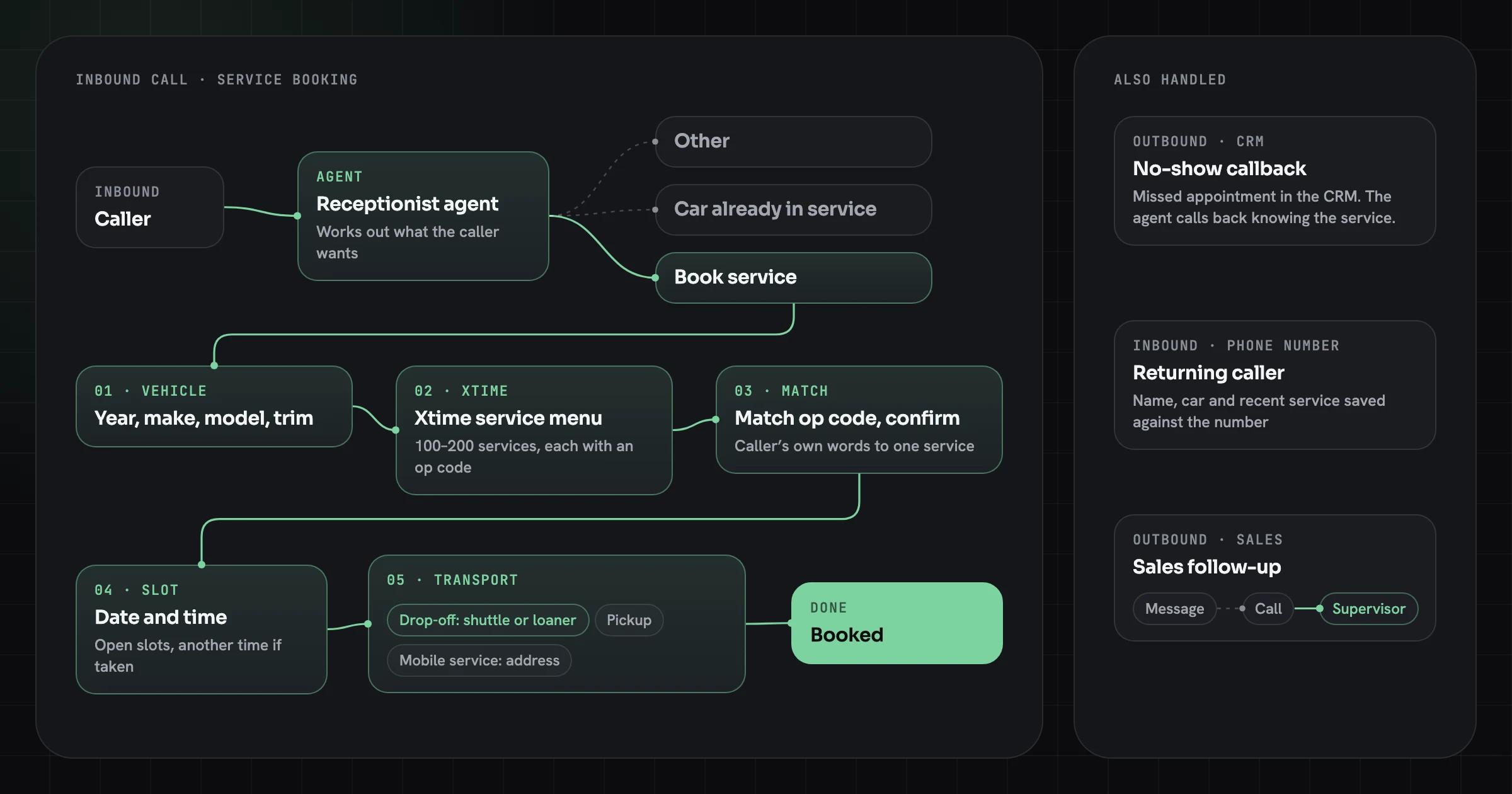
The integration is the cost that no per-minute quote shows, because it sits in the build. On the service booking agent we built for Innovative AI, every booking call loaded that vehicle’s own menu of 100–200 services from Xtime, checked the dealership’s open slots and settled drop-off, pickup or mobile service before it booked anything. In a build like this, each lookup is typically a tool the agent calls mid-conversation, and how AI service scheduling works at a dealership walks through them in order.
HIPAA and the BAA chain
A voice agent that hears patient information is only as compliant as the weakest vendor on the call. Under HIPAA, every vendor that receives protected health information must sign a business associate agreement, and on a voice call that is the carrier, speech-to-text, the language model, text-to-speech, the orchestration layer and wherever recordings and transcripts are stored.
Price this chain before you choose a stack. Vapi lists HIPAA-eligible data handling at $2,000 a month. Retell’s plan comparison lists HIPAA and a BAA on pay-as-you-go as well as enterprise, with a custom BAA on enterprise only (checked October 19, 2026). Twilio signs a BAA only for customers on its Security or Enterprise Edition. On a custom stack you sign each agreement yourself and can choose vendors and regions accordingly, which is often the deciding factor for healthcare work. There is no such thing as being “HIPAA certified”, so ask each vendor for its BAA, not a badge.
Outbound calls: consent rules change the cost
An agent that places calls costs more to build than one that answers them, because US law treats its voice as artificial. In February 2024 the FCC confirmed, in a declaratory ruling (FCC 24-17), that the TCPA’s restrictions on “artificial or prerecorded voice” cover current AI technologies that generate human voices. Such calls need the called party’s prior express consent, absent an emergency purpose or an exemption.
For a build, that turns into line items an inbound receptionist mostly avoids:
- consent capture and storage, tied to each number the agent may call,
- do-not-call list scrubbing before every campaign,
- an opt-out path inside the call that the agent honors at once,
- calling-hour limits by the recipient’s time zone,
- logs that show which consent covered which call.
Budget these as scope, not as a later fix; they decide whether the agent can dial at all. This is a summary of the ruling, not legal advice, and state rules can add to it.
Calls with a sales purpose count as telemarketing and need prior express written consent, so an unsold-lead callback carries a heavier consent flow than a reminder about a booked service, as our guide to no-show and unsold-lead follow-up calls explains.
When a platform is the right answer
For most first voice agents, a platform is the better choice. Choose one when:
- volume is under about 10,000 minutes a month and not growing fast;
- the call flow is standard, such as answering questions, booking into a common scheduler or taking messages;
- you want to test whether callers accept an AI agent before you invest in a build;
- or nobody will run voice infrastructure after launch.
Go custom when volume is high or rising, when compliance needs control over every vendor in the chain, when the agent must act inside your own systems in ways a platform’s integrations cannot, or when latency and voice quality are part of your product. Many teams start on a platform and move once the numbers above favor it; designing prompts and tools to be portable makes that move cheaper. The same trade-off applies to text agents, and our guide to build vs buy AI agents runs it over three years.
- Under about 10,000 minutes a month
- A standard call flow
- Testing whether callers accept an AI agent
- Nobody to run voice infrastructure
- High or rising volume
- Control over every vendor in the compliance chain
- Actions inside your own systems
- Latency and voice quality are part of your product
Is an AI voice agent worth it? Compare with missed calls
The right comparison is not the agent’s cost against a receptionist’s salary; it is the agent’s cost against the revenue lost to calls nobody answers. A business taking 60 calls a day at three minutes each uses about 5,400 minutes a month, which costs roughly $440 to $800 a month in platform usage at the list prices above.
Then estimate what missed calls cost you: calls a month, times the share you miss, times the share of those callers who would have bought, times the value of a customer. We walk through that model in what missed calls really cost, and you can run it with your own numbers in the AI voice agent ROI calculator. If the lost revenue is a multiple of the agent’s monthly cost, the case is easy at any of the prices in this guide.
How to lower the per-minute cost of a voice agent
The biggest savings come from the model and the voice, not from haggling over the platform fee.
- Use the smallest model that passes your call tests, and keep the system prompt stable so it can be cached.
- Pick a standard voice unless the voice is part of your brand; premium voices can cost several times more per minute.
- Keep calls short with clear flows and fast handoff to a person when the agent cannot help.
- Route by intent, so simple calls never reach the expensive model.
- Recheck list prices before you commit. This guide uses prices checked on October 18, 2026, and vendors update them; our AI voice agent pricing tracker rechecks them every month.
If you want these numbers worked out for your own call volume and systems, our AI voice agents team can model both routes in a free audit before you commit to either.
Sources
- Retell AI pricing, Retell AI
- Vapi pricing, Vapi
- API pricing (realtime and audio models), OpenAI
- Twilio Programmable Voice pricing (United States), Twilio
- Deepgram pricing, Deepgram
- Claude API pricing, Anthropic
- HIPAA compliance at Twilio, Twilio
- Implications of Artificial Intelligence Technologies on Protecting Consumers from Unwanted Robocalls and Robotexts, Declaratory Ruling (FCC 24-17), Federal Communications Commission
