


Fintech app development cost in 2026: real scopes
What a fintech app costs depends less on screens and more on who holds the money. Two real scopes, the line items that drive price, and how we quote.
Listen to the summary ·
Read the transcript
Switch lets a club’s treasurer issue a Visa debit card in seconds. Freedom Pro pays a partner network into USD and stablecoin wallets its members spend by card. We built both, and their scopes have almost nothing in common. That is why a single price range for a fintech app tells you so little.
The biggest cost decision is who holds the money. A licensed partner bank, card issuer or stablecoin provider has already built the hardest regulated pieces. You integrate them and build the product on top. Becoming the regulated entity yourself adds audits, licensing work and your own controls.
Agency guides checked October 18, 2026 run from about $25,000 for an MVP to $900,000 or more for a complex neobank. They disagree because each one prices a different product, team location and compliance scope.
Screens are rarely the expensive part. The cost sits in onboarding and KYC, in each money rail, in the ledger and reconciliation, and in the admin tools your operations team uses.
After launch, most running costs are usage-based provider fees, and over three years they can matter more than the build.
The cheapest build ships one money flow first on strong partners: cut scope, not controls. The guide below compares the two real scopes line by line.
AI-generated voice summary of this guide.

Switch lets a club’s treasurer issue a Visa debit card in seconds. Freedom Pro pays a partner network into USD and stablecoin wallets its members spend by card. We built both, both are “fintech apps”, and their scopes have almost nothing in common. That is why a single price range for fintech app development tells you so little.
We don’t publish client budgets, so there are no invented price tags for those two products here. There is what was in scope, why each piece costs what it does, and the prices we publish for our own engagements.
The short answer: what a fintech app costs in 2026
A fintech app costs what its money movement and compliance cost, not what its screens cost. The single biggest decision is whether a licensed partner holds customer funds while you build the product around it, or whether you take on that regulated role yourself.
For the first path, which is how most new fintech products launch, our published pricing is:
- Discovery Sprint: $5,000 fixed fee, 2 weeks. Scope, partner and compliance mapping, architecture, and a fixed price for the build. The fee is credited to the build.
- Fixed-Price Build: $25k–$120k per project, 6–16 weeks. Billed in milestones tied to demoed features, with 30 days of post-launch support.
- Dedicated Team: from $12k per month. For larger programs and the roadmap after launch.
Published agency estimates run wider, from about $25,000 for an MVP to $900,000 or more for a complex neobank. The next section shows why those numbers disagree, and the rest of this post shows which line items separate a first product on a partner’s rails from a neobank.
Why published fintech cost ranges disagree
Published fintech cost ranges disagree because each agency prices a different product, team location and compliance scope. Four 2026 guides from development agencies, with the figures copied as published:
| Source (date) | Smallest scope | Compliance-heavy or full scope | Largest scope | What it counts |
|---|---|---|---|---|
| RaftLabs (updated Oct 12, 2026) | Consumer fintech MVP: $30,000–$70,000, 12–18 weeks | Payments and compliance-heavy build: $80,000–$160,000, 16–30 weeks | Full platform: $140,000–$240,000+, 24–52 weeks | Says compliance adds 25–35% on top of the feature build |
| CMARIX (updated Aug 13, 2026) | Fintech MVP: $25,000–$60,000, 3–4 months | Full digital banking platform: $250,000–$600,000+, 9–14 months | “$600,000+ for enterprise banking platforms” | Ranges by app type |
| Acquaint Softtech (Jul 16, 2026) | Validation MVP: $50K–90K with a US team, $40K–80K with an EU team | Production and compliance: $150K–300K (US), $120K–260K (EU) | Enterprise platform: $350K+ (US) | Ranges by team region |
| Interexy (updated Mar 31, 2026) | Fintech MVP: $50,000–$120,000, regulated projects from $80,000 | Neobank MVP: $110,000–$160,000 | Complex neobank: $350,000–$900,000+, 12–20 months | Neobank as its own category |
Read side by side, three things explain most of the spread. Team location: Acquaint’s own table moves its MVP figure by about $10,000 between US and EU teams. Compliance scope: a product that becomes a regulated entity carries audits, licensing work and its own controls, while one built on a licensed partner inherits most of them. And what “MVP” means: RaftLabs’ smallest scope is a budgeting, expense-tracking or rewards app, while Interexy prices a neobank MVP separately at $110,000–$160,000. These are vendor estimates, ours included; none of them, and none of ours, is a price for your scope until the money flows are drawn.
The biggest cost decision: partner with a licensed provider or become one
Partnering with a licensed provider is cheaper and faster because the hardest regulated pieces, holding deposits, issuing cards and custody of digital assets, are already built and supervised. You integrate them through APIs and build the experience, the business logic and the controls on top.
The trade-off is dependency. Your product inherits the partner’s program rules, fees and onboarding timeline, and your users’ protection depends on that structure.
Our guide to stablecoin wallet integration covers this partner-first approach for digital assets in depth. Typical partner categories in a 2026 fintech build:
- Partner bank / banking-as-a-service for accounts, deposits, ACH and wires.
- Card issuing program for virtual and physical debit cards, spend controls and wallet provisioning.
- Stablecoin and wallet infrastructure, such as Bridge, which offers one API to move, store and accept stablecoins, plus wallets and a card program.
- KYC and identity verification for onboarding.


Both case studies below use this model.
Real scope 1: Switch, a shared banking app
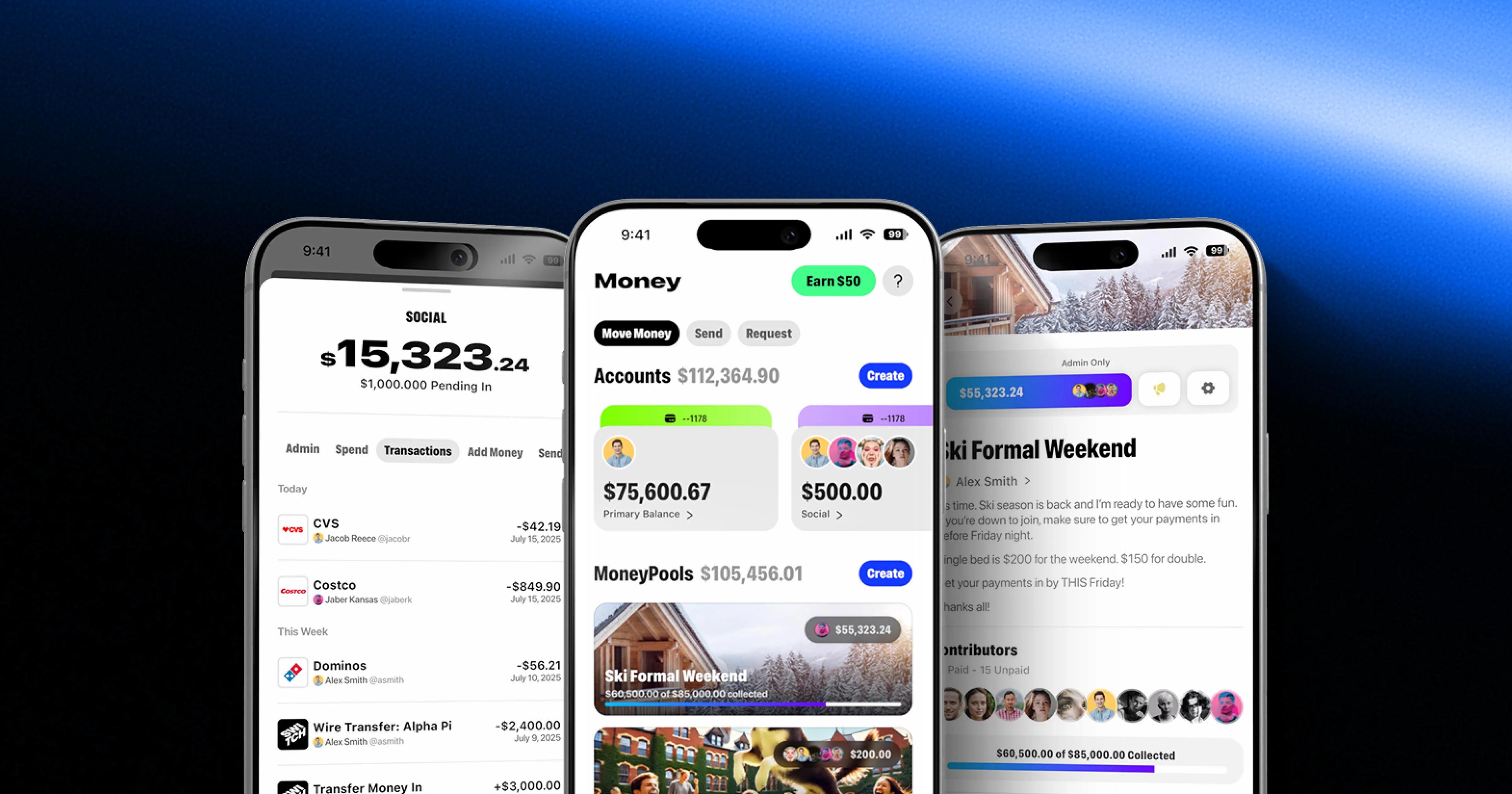
Switch is a banking app where clubs, teams and friends pool money, issue Visa debit cards in seconds and collect payments. It runs on iOS, Android and the web, with Thread Bank as its FDIC-insured partner bank. Here is what the scope contained, and why each part carries cost.
- Shared accounts with roles and permissions. Treasurers, admins and members each see and do different things. Permission models are a cost driver because every money action has to check them, and every one needs tests.
- Instant virtual and physical Visa debit cards. Spend limits, pause and close controls, plus Apple Pay and Google Wallet. Card issuing adds program integration, card lifecycle states and wallet provisioning flows.
- MoneyPools. Shareable collection links that work on the web with no download, with live tracking of who has paid. This is a second product surface, a public web flow, alongside the apps.
- Org tools. Multiple admins, one-tap handover to the next leader, QuickBooks sync and installment plans. Accounting sync means mapping transactions to someone else’s data model and keeping it in step.
- Full banking features from the partner: checks, cash deposits, wires and a fee-free ATM network.
What drove the effort was not the number of screens. It was the combination of three platforms, a permission model on every money action, card lifecycle handling and a public collection flow. The result: Switch is live on iOS, Android and web, has been adopted by 1,000+ organizations, and is rated 4.7 on the App Store. The details are in the Switch case study.
Real scope 2: Freedom Pro, a partner platform with wallets and cards
Freedom Pro is a direct-selling platform that bundles wireless, streaming, wellness and finance services and pays a partner network. Its fintech layer is a wallet: members hold USD and stablecoin balances and spend them by debit card. Its scope has little in common with Switch’s.
- Partner back office. Registration, team genealogy, ranks and commission tracking. Commission logic is business-critical code that needs reproducible calculations.
- USD and stablecoin wallets via Bridge. Earnings land in wallets members can hold or spend. Wallet integrations need balance reconciliation and clear state for every transfer.
- Debit card issuing. Members spend their balance anywhere by card.
- A member portal and single sign-on across several service verticals, plus an onboarding funnel that converts visitors into partners.
| Scope item | Switch | Freedom Pro |
|---|---|---|
| Money layer | Thread Bank, FDIC-insured partner bank | Bridge-powered wallets (USD and stablecoins) |
| Cards | Instant virtual and physical Visa debit, Apple Pay, Google Wallet | Debit cards on the member balance |
| Core logic | Roles and permissions on shared accounts | Genealogy, ranks and commissions |
| Extra surfaces | MoneyPools public web collection links | Member portal, onboarding funnel, service catalog |
| Integrations | QuickBooks sync, ATM network | Wireless, streaming and KYC providers |
| Platforms | iOS, Android, web | Web and mobile |
| Where the cost sat | Permissions, card lifecycle, three platforms | Money layer and commission engine |
Here the cost sat in the money layer and the commission engine, not in banking features. Comparing the two scopes is the point: both are “fintech apps”, and a single price range would describe neither. See the Freedom Pro case study for the full build.
Fintech app cost by product type
What drives cost changes with the kind of fintech product, so compare scopes of the same type. We don’t publish per-type prices; this table lists the drivers and the real case that maps to each, where we have one.
| Product type | Who holds the money | Main cost drivers | Our real example |
|---|---|---|---|
| Shared or consumer banking app | Partner bank | Roles and permissions, card lifecycle, multiple platforms, operations tools | Switch |
| Wallet or payouts on stablecoin rails | Stablecoin infrastructure provider | Transfer types, ledger and reconciliation, KYC states, cards | Freedom Pro |
| Bundled services platform | Several partners, one per service | Single sign-on, provisioning per provider, one account view | Freedom Pro |
| Lending | A lender or lending partner | Underwriting data, decision rules, repayment schedules, collections | None we can cite |
| Payments or merchant tools | Payment processor | Checkout flows, payouts, disputes, PCI scope | None we can cite |
A bundled platform is closer to financial aggregator development than to a banking app: most of its cost sits in connecting providers and keeping one view of the customer across them.
How long a fintech app takes to build
A focused first release on a partner’s rails typically takes 6–16 weeks of build after a two-week discovery, and partner approval often takes longer than the code. Banks, card programs and wallet providers each run their own onboarding, due diligence and program review. Start those conversations during discovery, so the build is not waiting for a sandbox key or a program sign-off in week eight.
The line items that drive fintech app cost
Every fintech quote is a sum of a few expensive line items and many cheap ones. These are the expensive ones, roughly in the order they move the price.
- Onboarding and KYC. Identity checks, document capture, failure and retry paths, manual review queues, and what the user sees while they wait.
- Money movement. Each rail (cards, ACH, wires, stablecoins) adds states, webhooks, failure handling and reconciliation.
- Ledger and reconciliation. Your record of balances has to match the partner’s every day, and someone needs a screen that explains any difference.
- Permissions and limits. Roles, spend limits and approvals, enforced on the server for every action.
- Admin and compliance tooling. Search, account holds, case notes, exports and audit logs for your operations team. It is often under-scoped and always needed.
- Security and PCI scope. The PCI Data Security Standard sets the baseline for handling payment card data. Using an issuer’s tokenized cards and hosted components keeps raw card numbers out of your systems and shrinks what you have to secure.
- Platforms. iOS, Android and web multiply UI and testing work. Our guide to native vs cross-platform apps covers that trade-off.
- Third-party integrations such as accounting sync, CRMs or data providers.
Design, marketing pages and settings screens matter, but they rarely decide whether a project lands at the low or the high end of a range.
How we turn a fintech scope into a fixed price
We price fintech work in two steps so the build price is fixed before you commit to it. The Discovery Sprint produces the scope; the build is then quoted as one fixed price, paid in milestones.
- Weeks 1–2Discovery SprintPartners, money flows, permissions and first-release scope.
- End of discoveryFixed build priceOne price for the agreed scope, with a milestone plan.
- 6–16 weeksFixed-price buildBilled in milestones tied to demoed features.
- After launchPost-launch supportIncluded with the build.
What the two-week discovery covers for a fintech product:
- Which partners hold funds, issue cards or verify identity, and what their APIs and program rules require.
- The money flows, drawn end to end, including failures and reversals.
- The permission model and the admin tools operations will need on day one.
- What is in the first release and what waits, with each cut explained.
- A fixed build price and milestone plan.
The build is then quoted as one fixed price inside the band above, set by what discovery found. If the program is bigger than that, for example several products or markets at once, a dedicated team from $12k per month is usually the better fit. Our post on how fixed-price software works explains what is fixed and what is not.
What a fintech app costs to run after launch
Running costs are mostly usage-based provider fees, and they can matter more than the build over three years. Get every provider’s fee schedule in writing during discovery, and model them against your expected users and transactions.
Typical running costs:
- Partner fees: banking program, card issuing and wallet provider fees, often per account, per card or per transaction.
- KYC fees: charged per verification, including the ones that fail.
- Hosting and monitoring: usually small next to provider fees for an early product.
- Security reviews and audits that partners or your own compliance team require.
- Ongoing development: partners change APIs and program rules, operating systems update, and regulations move.
How to cut fintech development cost without cutting compliance
The cheapest fintech build is the one that ships a narrow first release on top of strong partners. Cut scope, not controls.
- Launch one money flow first. For example accounts and cards, then collections, rather than every rail at once.
- Pick partners before you design screens. Their onboarding and program rules shape your flows.
- Keep raw card data out of your systems with tokenized cards and hosted components.
- Build the admin tools in the first release. Operations without tooling is the most expensive manual process in fintech.
- Use one codebase across platforms where performance and device features allow it.
Scope checklist before you ask for a fintech quote
Bring answers to these questions to any vendor, including us, and the quote you get back will be far more accurate:
- Who holds customer funds, and is that partner already chosen?
- Which money rails do you need at launch: cards, ACH, wires, stablecoins?
- Which platforms at launch: iOS, Android, web?
- Who are the user roles, and what can each one do with money?
- What does your operations team need to see and do every day?
- Which markets, and what has counsel said about licensing in each?
If you have those answers, request a Discovery Sprint and we will turn them into a fixed quote. You can also see how we approach the sector on our fintech software development page and our pricing page.
Sources
- Banking With Third-Party Apps, FDIC
- PCI Data Security Standard (PCI DSS), PCI Security Standards Council
- Bridge: stablecoin orchestration, issuance, wallets and cards, Bridge
- Fintech App Development Cost in 2026: Full Breakdown, Interexy
- Fintech app development cost in 2026: real numbers, RaftLabs
- How Much Does Fintech App Development Cost in 2026?, CMARIX
- Fintech app development cost, Acquaint Softtech
Mobile App Development
Native and cross-platform iOS and Android apps, from fintech and streaming to connected hardware, designed, built and launched to the stores.
