

How to choose an AI agent development company: a checklist
Twelve questions to ask any AI agent vendor, what a good answer sounds like, the contract clauses to insist on and the red flags. It ranks no one, and we answer the same questions ourselves.
Listen to the summary ·
Read the transcript
Every AI agent vendor’s demo looks good. Demos run on clean data and happy paths; production agents run on messy data and edge cases. This checklist of twelve questions tells the two apart and ranks no one. Because we build AI agents ourselves, we answer the same questions at the end.
Start with evidence. Ask to see an agent running in production, or a customer you can call, and ask what broke after launch. Good answers name a failure and the fix.
Ask the vendor to write down what the agent may do, what it may only propose, and what it must never touch. The OWASP Top 10 for LLM Applications lists excessive agency as one of its ten main risks, and prompt injection comes first on that list.
Ask how they will build an evaluation set from your real cases, and what pass mark counts as good enough to launch. Any accuracy promise made before seeing your data is a guess.
The code, prompts and evaluation sets should be yours in the contract, deployable in your own cloud account. Compare what is fixed, not the headline number.
A good vendor will also tell you when not to build an agent. The guide below has all twelve questions, the red flags and a scoring sheet you can copy.
AI-generated voice summary of this guide.

Choosing an AI agent development company is hard because every vendor’s demo looks good. Demos run on clean data, happy paths and a presenter who knows what to type. Production agents run on messy data, edge cases and users who don’t. This checklist is built to tell those two apart.
It is vendor-neutral on purpose. It ranks no one, it recommends no list, and it works for any team you are talking to. Disclosure: Apptycoons builds AI agents, so at the end we answer the same twelve questions about ourselves, and you can hold us to them.
Why demos are a poor way to choose an AI agent vendor
A demo shows that a model can do a task once; a production agent has to do it thousands of times, safely, with a record of what it did. The questions that separate vendors are about evaluation, permissions, failure handling and ownership, and none of them show up in a demo.
It also helps to know what a good vendor will often recommend: less agent than you expected. Anthropic’s engineering guidance on building agents advises finding the simplest solution possible and adding complexity only when needed, and distinguishes fixed workflows from agents that direct their own steps. A vendor who proposes a simple workflow where it fits is usually a better sign than one who proposes a multi-agent system for everything.
1. Can they show an agent running in production?
The strongest evidence is a live product you can use, or a customer you can call. Ask what the agent does, how long it has been live, what broke after launch and how they found out.
Good answers are specific: a monitoring dashboard, a class of failure they didn’t expect, the fix and the test they added. Weak answers stay at the level of frameworks and model names.
2. Do they start from your workflow, not their framework?
A good vendor asks about the job before the stack: what triggers it, who does it now, what systems it touches, what a correct result looks like and what a mistake costs. If the first meeting is about frameworks and vector databases, the scoping hasn’t started.
Ask them to describe the first agent in one sentence, with one metric. If they can’t, the project will drift.
3. Can they say what the agent will not do?
Scope is defined as much by exclusions as by features. Ask the vendor to write down which actions the agent may take, which it may only propose, and which it must never touch.
This maps to a real security risk. The OWASP Top 10 for LLM Applications 2025 lists excessive agency, an AI system given more functionality, permissions or autonomy than it needs, as one of the ten main risks. The fix is design, not a disclaimer: least-privilege tool access, separate credentials, and approval steps for anything irreversible.


4. How will they evaluate the agent before and after launch?
An agent without an evaluation set cannot be improved safely. Ask how the vendor will build a test set from your real cases, what score counts as good enough to launch, and how every change to a prompt, model or tool is re-scored before it ships.
- DiscoveryBuild a test setFrom your real cases, not a curated demo set.
- Before the buildAgree a pass markThe score that counts as good enough to launch.
- Before launchScore the agentAgainst the test set and the agreed pass mark.
- Every changeRe-score before it shipsEach prompt, model or tool change, including model updates.
Good answers include real examples from your data, a pass mark agreed before the build, and regression testing when models change.
5. How do they defend against prompt injection and data leaks?
Ask directly how they handle prompt injection, the first risk on the OWASP list, and sensitive information disclosure, the second. Any agent that reads email, documents, web pages or user input can receive instructions hidden in that content.
Look for layered answers: untrusted content treated as data, tools scoped to the minimum, outputs validated before they trigger actions, sensitive data redacted, and model endpoints configured not to retain your data. Our AI agent guardrails checklist maps ten such controls to the OWASP risks, so you can ask which of them the vendor builds by default.
6. Where does a human approve, and is every action logged?
Every consequential action should have a clear owner. Ask where in the flow a person reviews or approves, how the agent escalates when it is unsure, and whether every action is logged with its inputs and outputs in a way an auditor could follow.
If your industry is regulated, ask how the logs map to your existing controls. Frameworks such as NIST’s AI Risk Management Framework, a voluntary framework for managing AI risk, give you a shared vocabulary for that conversation.
7. Which models do they use, and can you switch?
Models change every few months, so lock-in to one provider is a cost. Ask whether the architecture is model-agnostic, how a model swap would be tested, and what happens to cost and latency if you move.
A good answer is often “we pick per task”. Combined with an evaluation set, that lets you change models with evidence rather than hope.
8. How will it connect to your systems?
Most of the work in an agent project is integration, not prompting. Ask which of your systems the agent reads from and writes to, how authentication works, what happens when an API is down, and whether the agent can do anything a normal user with the same role could not.
9. Who owns the code, prompts, evaluations and data?
You should own everything that makes the agent work: code, prompts, evaluation sets, infrastructure configuration and documentation. Ask for it in the contract, and ask whether the agent can run in your own cloud account.
Then ask the uncomfortable question: what happens to the agent if the vendor disappears? If the answer involves their proprietary platform, you are renting, not buying.
10. What is fixed in the price?
Compare what is fixed, not the headline number. Ask whether there is a paid discovery phase, whether the build price is fixed after it, how payments map to delivered features, and what running costs (model usage, hosting, monitoring) you should expect.
Open-ended time-and-materials with no discovery is not wrong, but it moves all of the risk to you. Our AI agent development cost guide breaks down what a build and its running costs usually include, so you can check a quote line by line.
11. What happens after launch?
Agents need care after launch: models update, data drifts, and users find new edge cases. Ask what support is included, how monitoring works, who watches cost and success rate, and how improvements are scoped.
12. Will they tell you when not to build an agent?
The best signal of an honest vendor is a recommendation against their own interest. Ask: “What would you not automate here?” A good partner will point to steps where a rule, a form or a person is cheaper and safer than a model, or to an off-the-shelf agent that already does the job. Our build vs buy framework for AI agents is a useful way to test that advice.
What to put in the contract
The contract is where the answers to questions 9 to 11 become enforceable. A vendor who answered them well on a call should have no trouble writing them down. Before you sign, check that it covers:
- IP assignment: the code, prompts, evaluation sets, tool definitions and any fine-tuning data are assigned to you, not licensed.
- Accounts: model provider, cloud and monitoring accounts are opened in your company’s name, with the vendor as a user you can remove.
- Data processing: what data the vendor and each model provider may store, where and for how long; for EU personal data that means a data processing agreement (see our guide to the EU AI Act and GDPR for AI agents).
- Acceptance: launch is accepted against the evaluation set and pass mark agreed in discovery, not against a demo.
- Handover: the repository, infrastructure as code, a runbook and the evaluation set are delivered at the end, whether or not you renew.
- Support: how long post-launch support lasts and what a change costs once it ends.
None of these clauses is unusual in software contracts. What changes for AI agents is the list of assets: prompts and evaluation sets are as much part of the product as the code. This is a buyer’s checklist, not legal advice; have counsel review the final terms.
How to check a certification claim
Ask for the document behind the badge, then read its scope and date. A certification or report that covers a vendor’s office IT, or expired last year, says nothing about the team that will build your agent.
- ISO/IEC 42001 is the management-system standard for AI, published on December 18, 2023. A vendor claiming it should show a certificate naming the issuing body, the scope and the validity dates.
- SOC 2 is not a certificate. The AICPA describes it as reporting on an examination of controls at a service organization, carried out by a CPA firm. Ask for the report itself under NDA, check which services it covers and the period it tested.
- “HIPAA certified” does not exist. For health data, ask whether the vendor will sign a business associate agreement and which of its subprocessors will too.
A vendor without a certification can still be the right choice for a first agent if it answers the twelve questions above with evidence. What matters is that any claim on the website matches the document behind it.
Red flags when choosing an AI agent developer
These are the patterns that should end a conversation or at least slow it down:
- Accuracy or savings figures promised before anyone has seen your data.
- No evaluation set, or “we test it manually”.
- No answer on prompt injection or excessive agency.
- Write access to production systems with no approval step.
- Prompts, evals or orchestration kept as the vendor’s intellectual property.
- A demo built on data that is not yours, presented as proof.
- No discovery phase, and no clear statement of what is fixed.
A scoring sheet you can copy
Score each vendor from 0 to 2 on each line (0 = no answer, 1 = general answer, 2 = specific evidence). Compare totals only after the calls, and weigh the first four lines double.
| Criterion | What a 2 looks like | Weight |
|---|---|---|
| Production evidence | Live product or callable reference | Double |
| Evaluation | Test set from your data, agreed pass mark, regression testing | Double |
| Limits and approvals | Written action boundaries, human approval, audit log | Double |
| Security | Prompt injection, data leakage and data retention answered specifically | Double |
| Workflow fit | First agent in one sentence with one metric | Single |
| Integration | Systems, auth and failure handling explained | Single |
| Model flexibility | Model-agnostic, swap tested with evals | Single |
| Ownership | Code, prompts and evals yours, deployable in your cloud | Single |
| Pricing clarity | Discovery, fixed scope, milestone payments, run costs | Single |
| After launch | Monitoring, support and improvement process | Single |
Our answers to the same questions
Here is how Apptycoons answers the checklist. Hold us to it, and ask us for the evidence on a call.
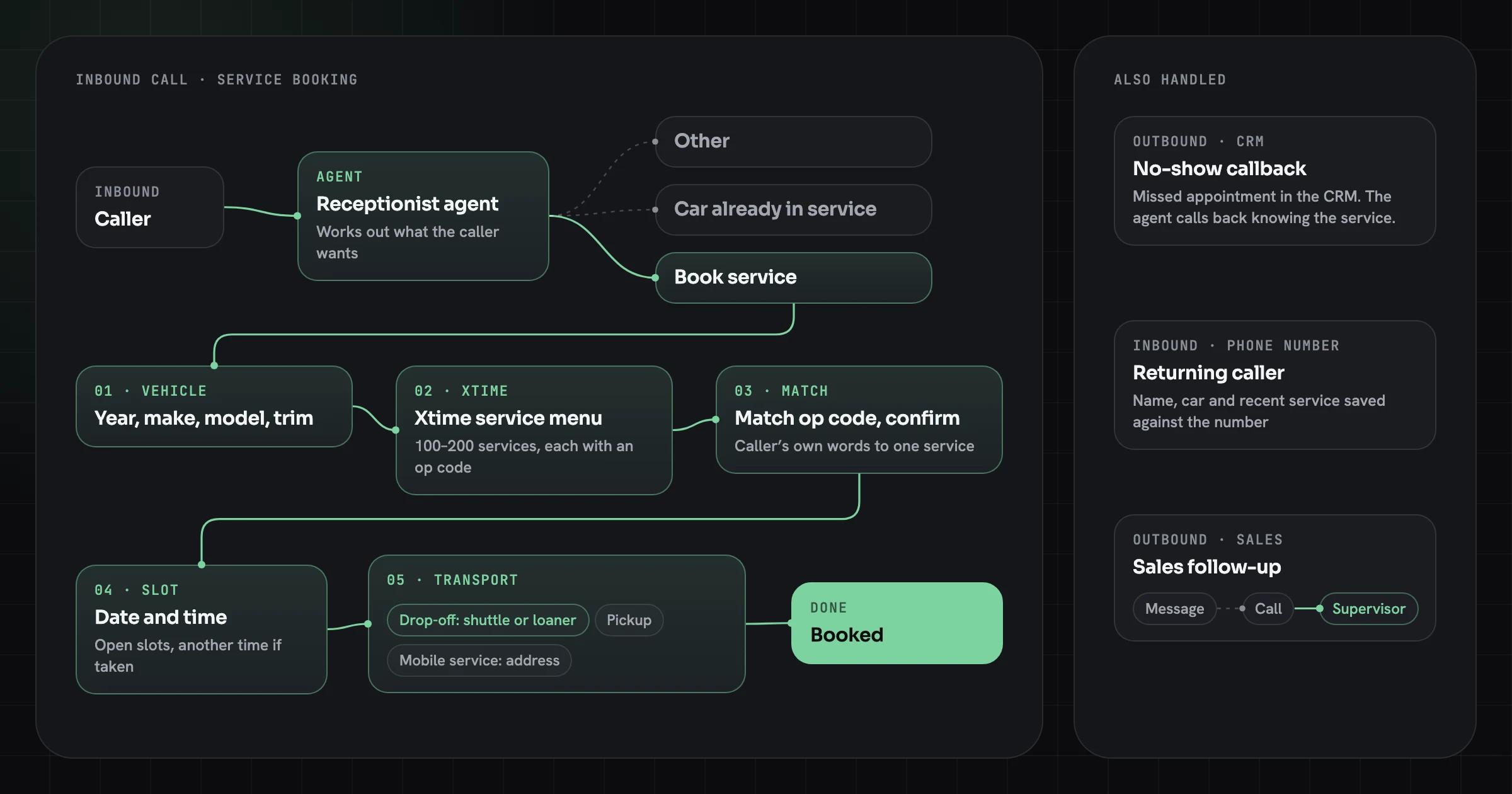
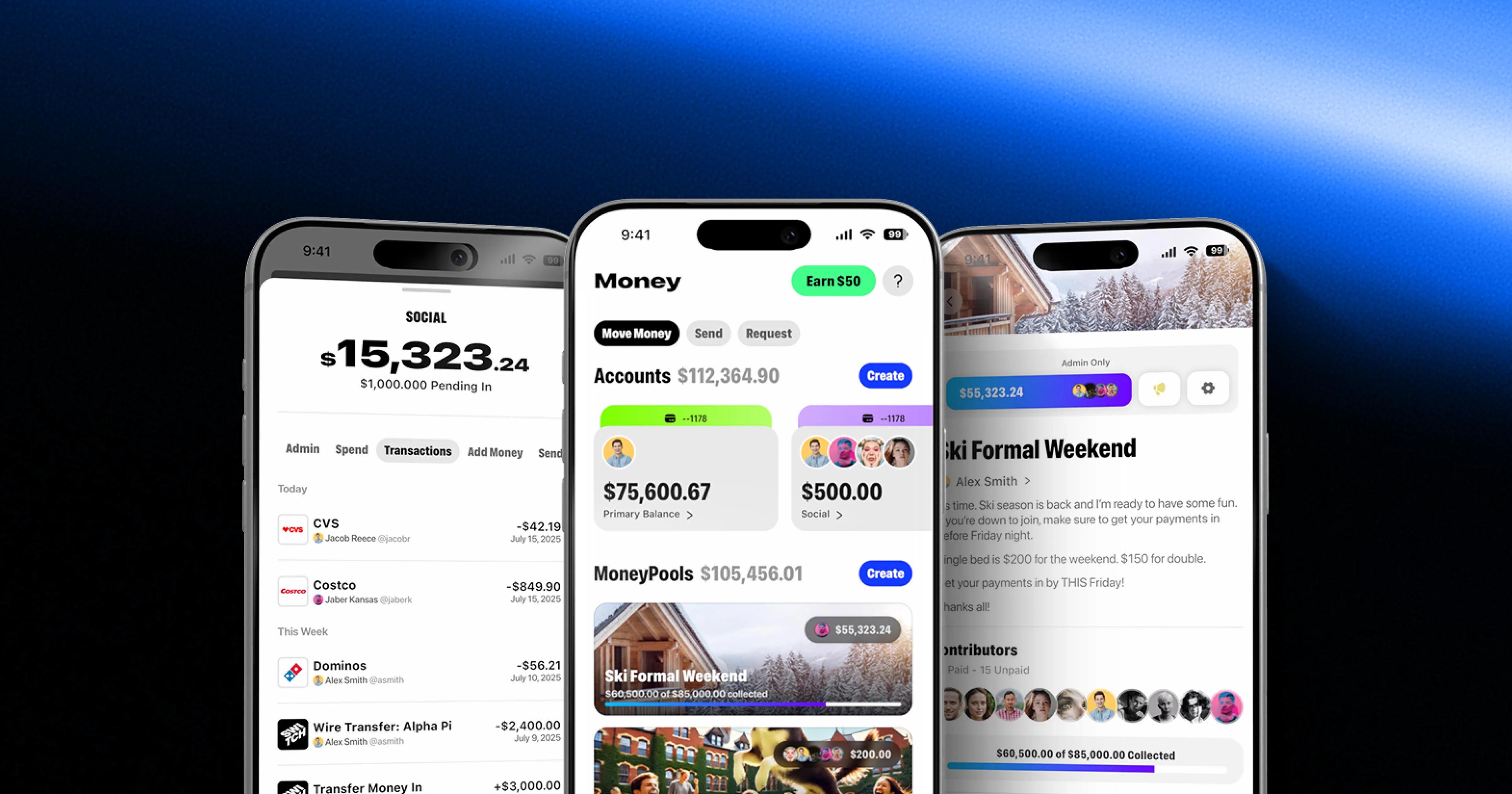
- Production evidence: Innovative AI, voice agents for US car dealerships that matched callers’ requests to a service on the vehicle’s menu, read it back and booked it in Xtime, and Superdeal, an AI agent that runs creator campaigns with the brand approving every step. Both are live products, and both case studies show how the work was built.
- Workflow first: our process starts by mapping one workflow and one metric.
- Limits and approvals: approval steps, escalation rules and full audit logs for every action. On Superdeal, every consequential step goes Draft, Review, Send.
- Evaluation: a test set built from your real cases, scored before launch and again after every prompt, model or tool change.
- Security: least-privilege permissions, PII redaction and zero-retention model endpoints, so your data does not train public models.
- Models: we choose per task from Anthropic, OpenAI, Google or open-source models and keep the model swappable.
- Ownership: the code lives in your repository from day one, the IP is yours, and the agent runs in your cloud or on endpoints you control.
- Pricing: published on our pricing page. Discovery is two weeks at $5,000, credited to the build; builds are fixed at $25k to $120k; a Dedicated Team starts at $12k a month. Every build includes 30 days of post-launch support.
- When not to build: if a rule or a form solves the problem, we will say so. Our post on taking AI pilots to production covers why so many stall.
If that matches what you need, our AI agent development page has the details, and a free AI audit is the fastest way to test our answers against your workflow.
Sources
- Building effective agents, Anthropic
- OWASP Top 10 for LLM Applications 2025, OWASP GenAI Security Project
- AI Risk Management Framework, NIST
- ISO/IEC 42001:2023 Information technology, Artificial intelligence, Management system, IEC Webstore
- System and Organization Controls: SOC suite of services, AICPA & CIMA
AI Agent Development
We design and build autonomous AI agents and multi-agent systems that read, decide and act across your tools, with human approval where it matters.
